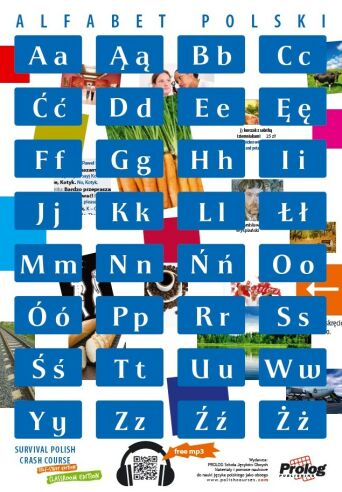
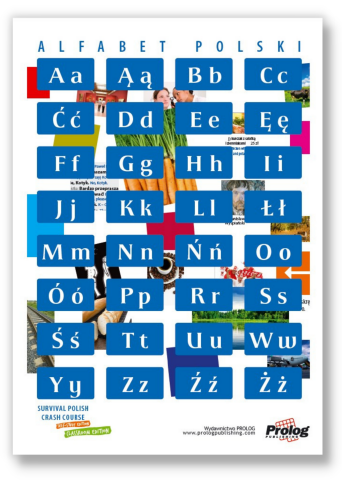
The poster “Alfabet polski” in the size of 84 cm x 56,5 cm, which is an extremely useful teaching aid for a teacher of Polish as a foreign language, will decorate the wall of the studio and help to familiarize students with the Polish alphabet.The code on the poster refers to the location from where you can download a free mp3 file with the alphabet read out. When purchasing the poster and book positions, the poster is sent in folded form. When purchasing only the poster - shipped in a tube. If the order is to be divided into 2 packages, then a surcharge for the second shipment is required (contact books@prolog.edu.pl).
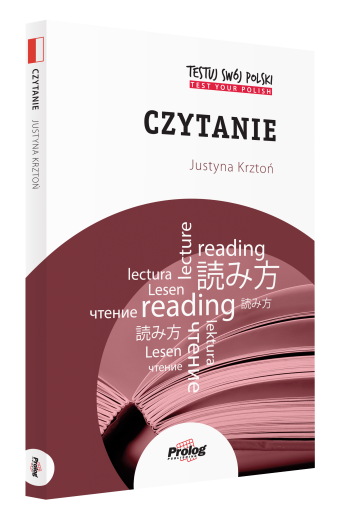
"TEST YOUR POLISH – Reading" is the perfect book for those who would like to develop their reading skills in Polish. The carefully selected material is stylistically varied, most of it being from the Polish press and literature. Both Facebook and fairy-tale lovers will find some interesting texts in here. There are useful information reference resources for tourists and cyclists traveling around Poland, as well as something for those who are in love with Polish cuisine and are interested in Polish literature and culture. For all, regardless of age, gender and height – a huge dose of humour. In one word – read! Comprising seventy exercises, "TEST YOUR POLISH – Reading" can be used for selfstudy and as extra material for your classes. To make the book friendly to the selfstudy learner, an answer key; glossaries: Polish – English and Polish – German are included. Can be used by both adults and teenagers learning Polish at levels A2-C1 (according to CEFR).
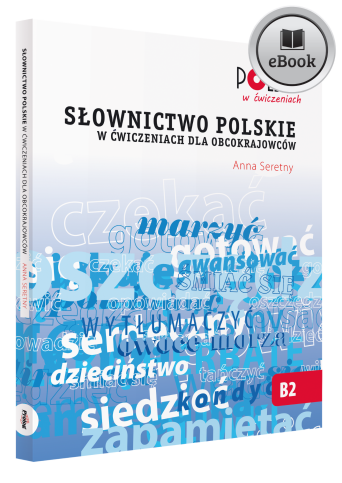
Polish vocabulary in exercises (Słownictwo polskie w ćwiczeniach) is a collection of exercises arranged thematically which are geared toward foreigners learning the Polish language at the B2 level. Mastering the vocabulary, put together in this book, will enable them to undertake and effectively implement of a broad spectrum of linguistic functions: receptive, productive, and mediation, because ... they will not be at a loss for words. The collection consists of 20 thematic units, assembled in 4 modules finishing with "a test of vocabulary." Each unit contains several varied exercises. They enable learners to hone their skills of both self-discovery of the meaning of new words and recording them, as well as using them in various activities.In the exercises, most of which are based on texts about current moving problems, the following techniques were used:• matching words with their definitions;• open and controlled clozes;• text completion using given words;• collocation completion;• matching set phrases;• register transformation;• paraphrasing;• word transformation;• word puzzles;• formulation of lexically controlled responses (brief or expanded). Polish vocabulary in exercises (Słownictwo polskie w ćwiczeniach) can be used as a textbook to work with, under the guidance of a teacher. The book will also be helpful to learners in their independent globetrotting search for words.
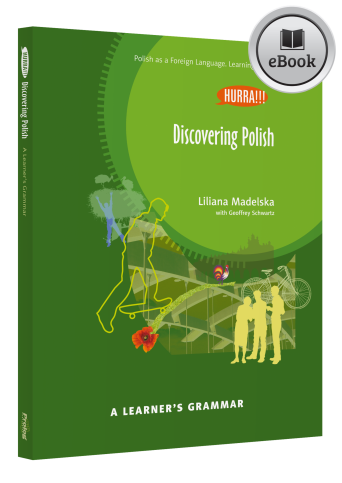
Learner's Grammar for Polish as a foreign language (in three languages: Polish, English and German) is a systematic presentation of Polish grammar through which the author invites learners to have fun and independently 'discover' the grammatical structures of the Polish language. Such a method of introducing the complexity of Polish grammar is especially learner-friendly and motivating. In turn, many humorous examples, sample sentences and illustrations explaining more challenging grammar problems facilitate the acquisition and retention of grammar rules. For those who prefer a more traditional approach to learning, the author presents clear tables and commentaries.Learner's Grammar in English and German have been compiled comparatively. This allows foreign language learners to quickly grasp structural differences between Polish and English, and Polish and German respectively, which in turn leads to a more swift acquisition of Polish grammar.
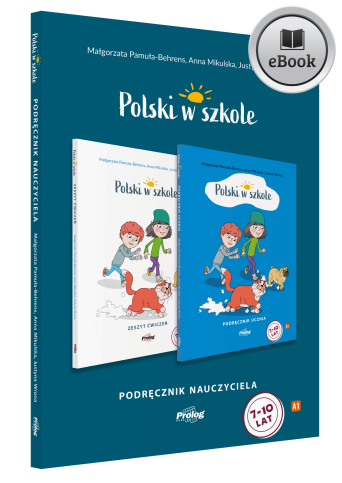
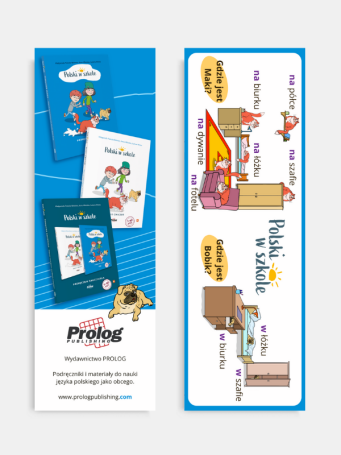
Przegląd podręcznika Polski w szkole. Podręcznik nauczyciela. Polski w szkole - is a modern series for learning Polish for children aged 7-10 for whom Polish is a foreign language, a second language or an inherited language. Polski w szkole is an innovative series for pupils aged 7–10 who are beginning systematic learning of the Polish language. The series is intended for 120 hours of learning and covers the content specified in the CEFR at A1 level. The series includes: a pupil's book with audio recordings, an exercise book and a teacher's textbook with access to additional materials in the Teacher's Zone. Iga and Filip, together with their parents, cousins and friends, as well as their beloved animals, will introduce children to the world of the Polish language, Polish culture and customs. While learning, children learn the language needed for everyday communication and the language of school education needed to learn mathematics, nature, music and other areas of school education. Language games and projects give pupils a chance to practice and demonstrate what they have learned. A clear structure that helps learning. Carefully selected materials, dialogues, games and activities encourage creative and effective learning. The Polski w szkole series was prepared in accordance with the guidelines of the regulation of the Minister of National Education regarding the approval of textbooks for school use. Illustrations, photos, maps, tables create a colorful world in which the characters of the textbook live. The teacher's manual is an essential tool for implementing lessons in the Polish at School series. For experienced teachers it can be a source of new teaching ideas and inspiration, and for people who are just starting to teach Polish as a foreign language, this material is an indispensable support in preparing classes. The teacher's manual contains: description of the series and the didactic solutions undertaken, its most important assumptions and working methods, explanations of selected cultural issues, suggestions for working with instructions, proposals regarding how to assess and maintain a language portfolio, 120 ready-made lesson plans, list of materials that will be needed to complete the lessons, access to the Teacher's Zone, where you can download ready-made teaching materials: illustrations for printing, photos, worksheets, game boards, MP3 recordings, transcripts and more. Sample pages: In the Teacher Zone you will find: MP3 recordings for the student's textbook. Downloadable files in the form of print-ready PDFs, which are an integral part of the teacher's manual. With their help, you can teach and play with the children, which diversifies the class activities. The materials have been prepared for specific lessons, and their presence in the Zone improves the teacher's preparation for classes. Additional materials, games and exercises. Access to all materials is free for all who purchased the book. The access code, located on the inside cover, should be entered in the appropriate place on the publisher's website. Kod dostępu, zamieszczony na wewnętrznej okładce, należy wpisać w odpowiednim miejscu na stronie wydawnictwa. Prezentacja podręcznika i metod pracy z serią Polski w szkole.
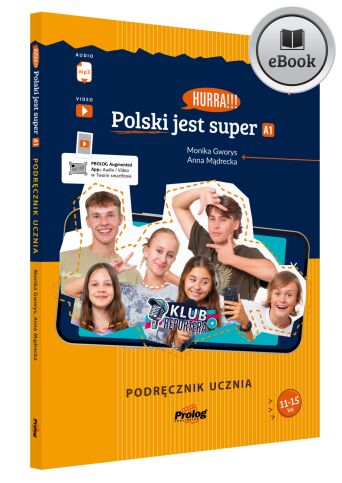
Obejrzyj przeglądy podręczników "Hurra!!! Polski jest super. A1" HURRA!!! Polski jest Super. A1. Student’s Textbook: The textbook is developed in line with the examination standards of the State Commission for the Certification of Proficiency in Polish as a Foreign Language. is a textbook for learning Polish as a foreign, second, or heritage language is primarily intended for students aged 11–15 (grades IV–VIII of primary school) covers 120 teaching hours and A1-level content (CEFR 2020) consists of 20 chapters and an introductory chapter 0 develops communicative and action-oriented skills from the very first lessons helps shape modern linguistics key competences The textbook stands out for: topics that are important to young people: friends, hobbies, sports, music, school, and more characters who are peers of the school “Reporter’s Club” a balance between building and developing language skills and teaching vocabulary and grammar a variety of task types and learning / teaching techniques online games (QR codes included in the textbook) 25 videos that immerse students in the target language NOVELTY - board games and language activities end-of-chapter projects that answer the question posed in the chapter title all audio and video recordings available on a phone via the PROLOG Augmented App, free to download from Google Play and the App Store. The student’s textbook is designed for use under teacher supervision. Each chapter contains 2–3 language games to practice introduced vocabulary and grammar. In total, the textbook includes 56 games, accessible by scanning the QR code in the exercise. Types of online games in the textbook: wheel of fortune, gap-filling, matching pairs, quiz. The protagonists of the textbooks, videos, and audio recordings are a group of teenagers of various ages united by a shared passion for journalism. Together, they run the REPORTER’S CLUB blog. They record videos, present not only school life but also their passions, talk about travels, holidays, family, home, and various events important to them. Watch a sample DVD: Students can access the videos in the textbook via the PROLOG Augmented App. Play sample games: Sample pages: I would like to emphasize that there has not yet been a publication on the Polish publishing market addressed to the target group indicated by the authors that constitutes such a comprehensive whole. An additional advantage of the publication is its full alignment with the communicative and action-oriented approach. Thus, it motivates learners by showing that they acquire skills they can use outside the classroom. (…) The work deserves recognition and will not only raise the language competence of learners and interest young people in Poland, but also motivate them to continue learning. The textbook and its accompanying materials encourage young learners not only with content that allows them to describe the world and their experiences in Polish, but also with the format of the materials. It motivates them to engage in language activities and to become autonomous in their learning process (not “I learn the language because I have to,” but “I want to”). The graphic and audiovisual design is an asset. Likewise, the inclusion of numerous games and language activities addresses the element of competition and active student participation.— from the review by dr hab. Aleksandra Achtelik, prof. UŚ
PHONETICS (FONETYKA) is a new entry in the series TEST YOUR POLISH (TESTUJ SWÓJ POLSKI). Foreigners will find a wide selection of exercises devoted to pronunciation and differentiation, among others, between a series of problematic alveolo-palatal consonants (ś, ź, ć, dź), postalveolar consonants (sz, ż, cz, dż), consonant clusters (ść, szcz, źdź, żdż) or nasal vowels ą, ę. Tasks contained in PHONETICS (FONETYKA) will also help to check and systematize materials related to intonation, accent and phonetic changes that occur in the Polish language within the same word, as well as the whole sentence. An integral part of PHONETICS (FONETYKA)are recordings, for the purpose of, among others, presenting model pronunciation of all the vowels and consonants. Thanks to the recordings, learners of Polish as a foreign language can improve the perception and differentiation of certain sounds, and also have the opportunity to compare their own pronunciation with the model pronunciation of Polish teachers. The exercises in PHONETICS (FONETYKA) are designed for individual work, but can also be used by teachers for group courses as supplementary course material. In order to do the exercises properly, knowledge of specific vocabulary or grammar is not required, because students from levels A1-A2 and even individuals just beginning to learn the Polish language can work with PHONETICS (FONETYKA),. The book includes:• 70 varied phonetic exercises with answer key• recordings for most exercises• interesting facts about phonetic changes• practical information about the formation and differentiation of sounds• collation of Polish sounds with their equivalents in English• humorous drawings to facilitate the understanding of certain phonetic problems• access to the app with illustrated audio flashcards (Google Play and App Store)• Mini-dictionary PL / ENG / DE You can download the Prolog Augmented App from Google Play and the App Store:
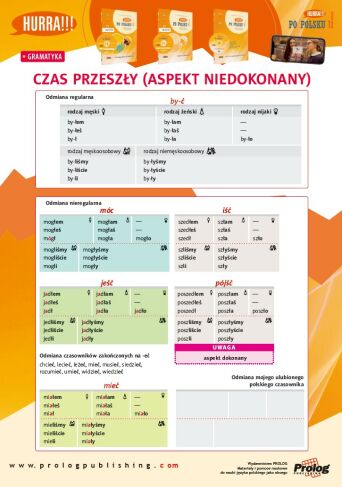
The poster "Czas przeszły. Aspekt niedokonany" in the size of 68 cm x 48 cm is an extremely useful teaching aid for a teacher of Polish as a foreign language. It will decorate the wall of the studio and help to master the structures of the past tense in the imperfect aspect. The material comes from the student textbook "HURRA!!! In Polish 1". When purchasing the poster and book positions, the poster is sent in folded form. When purchasing only the poster - shipped in a tube. If the order is to be divided into 2 packages, then a surcharge for the second shipment is required (contact books@prolog.edu.pl).
"Ortografia polska w ćwiczeniach dla obcokrajowców" is the first comprehensive collection of exercises of Polish orthography written specifically for foreigners. The author, Dr. Elizabeth Zarych, has used her experience gained at the Jagiellonian University in the course of working with students, including Erasmus scholarship holders and translators. Issues that are particularly problematic for foreigners are comprehensively presented In 10 chapters. The rules of spelling are explained in detail and are accompanied by a variety of exercises, among which are: Pronunciation- spelling exercises, Word formation exercises, Clozes, Grammar tables, Diagrams, Language games, Recipes, Literary works, Songs, Dictations. In the learning of orthography, funny pictures also help in memorizing rules.The book can be used both as a self-learning book (answer key included) as well as a book to be used by a teacher in a classroom.The book includes a CD with MP3 audio recordings of exercises as well as dictations read at different speeds.The mp3 files can also be download from the web - using code from the CD.
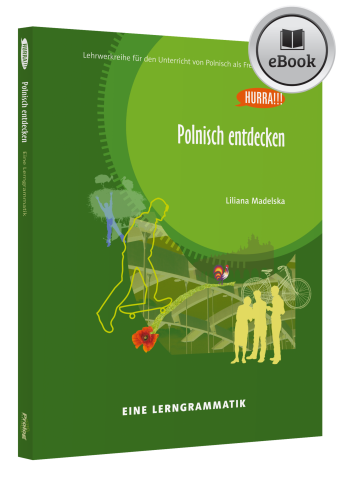
Learner's Grammar for Polish as a foreign language (in three languages: Polish, English and German) is a systematic presentation of Polish grammar through which the author invites learners to have fun and independently 'discover' the grammatical structures of the Polish language. Such a method of introducing the complexity of Polish grammar is especially learner-friendly and motivating. In turn, many humorous examples, sample sentences and illustrations explaining more challenging grammar problems facilitate the acquisition and retention of grammar rules. For those who prefer a more traditional approach to learning, the author presents clear tables and commentaries.Learner's Grammar in English and German have been compiled comparatively. This allows foreign language learners to quickly grasp structural differences between Polish and English, and Polish and German respectively, which in turn leads to a more swift acquisition of Polish grammar.
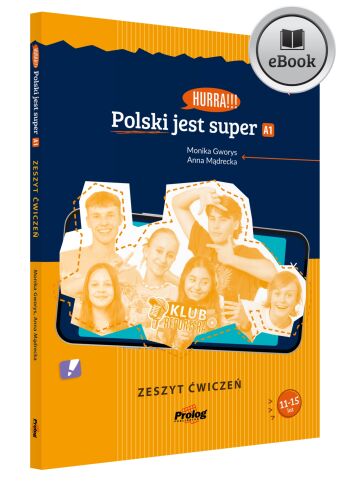
Obejrzyj przeglądy podręczników "Hurra!!! Polski jest super. A1" HURRA!!! Polski jest Super. A1. Workbook: The textbook is developed in line with the examination standards of the State Commission for the Certification of Proficiency in Polish as a Foreign Language. consists of 20 chapters and an introductory chapter 0 systematizes the vocabulary and grammar contained in the student’s textbook develops reading comprehension and writing skills uses engaging task types: mazes, crosswords, rebuses, coding, word searches the learning techniques used are also suitable for independent work at home clear layout and simple instructions facilitate independent student work answer key enables self-assessment The workbook allows for independent work with the vocabulary and grammar material from the “Polski jest Super. A1” Student’s Textbook. The protagonists of the textbooks, videos, and audio recordings are a group of teenagers of various ages united by a shared passion for journalism. Together, they run the REPORTER’S CLUB blog. They record videos, present not only school life but also their passions, talk about travels, holidays, family, home, and various events important to them. Sample pages: I would like to emphasize that there has not yet been a publication on the Polish publishing market addressed to the target group indicated by the authors that constitutes such a comprehensive whole. An additional advantage of the publication is its full alignment with the communicative and action-oriented approach. Thus, it motivates learners by showing that they acquire skills they can use outside the classroom. (…) The work deserves recognition and will not only raise the language competence of learners and interest young people in Poland, but also motivate them to continue learning. The textbook and its accompanying materials encourage young learners not only with content that allows them to describe the world and their experiences in Polish, but also with the format of the materials. It motivates them to engage in language activities and to become autonomous in their learning process (not “I learn the language because I have to,” but “I want to”). The graphic and audiovisual design is an asset. Likewise, the inclusion of numerous games and language activities addresses the element of competition and active student participation.— from the review by dr hab. Aleksandra Achtelik, prof. UŚ
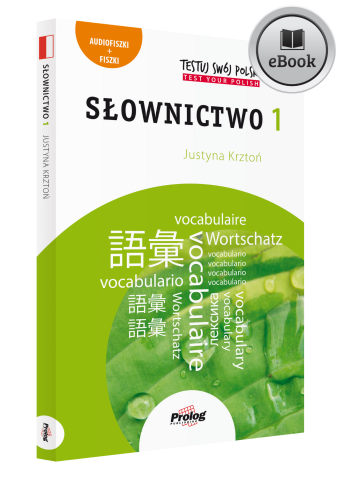
"TESTUJ SWÓJ POLSKI – SŁOWNICTWO 1" (TEST YOUR POLISH – VOCABULARY 1) is the first in the series of eight self-study books "TESTUJ SWÓJ POLSKI" (TEST YOUR POLISH).Consists of:• 70 vocabulary tests + key• variety of motivating tasks – multiple choice, gap-fills, cartoons, matching exercises and many other• dictionary PL / ENG / DE• tips for learners • instructions in PL and ENG • downloadable 471 illustrated prompt cards • downloadable mp3 prompt cards recordins • Access to the app with illustrated audio flashcards (Google Play and App Store) For self-study and classroom use. Can be used by both adults and teenagers learning Polish at levels A1-A2. You can download the Prolog Augmented App from Google Play and the App Store: Each flashcard contains the MP3 track number, chapter number, book title, an illustration of the word or phrase, and translations in five languages on the back of the card.
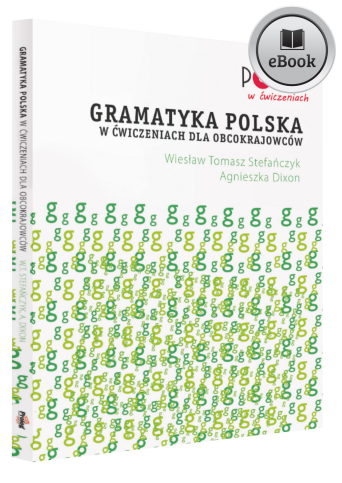
Gramatyka polska w ćwiczeniach dla obcokrajowców is a textbook designed for beginner foreigners who are learning at levels A1 and A2. The textbook consists of 9 main chapters: grammatical gender, noun, adjective, adverb, pronoun, numeral, verb, syntax, preposition. Each of them is composed of subchapters addressing specific grammatical topics taught at the A1+ level. Theoretical explanations are accompanied by corresponding exercises. Polish Grammar in Exercises for Foreigners is suitable for self-study as well as supplementary material for courses. Within the textbook, you will find: precise grammatical explanations (even-numbered pages), systematic exercises (odd-numbered pages), illustrations presenting individual topics, information on the frequency of use of grammatical structures, interesting facts about Polish grammar, key for exercises.
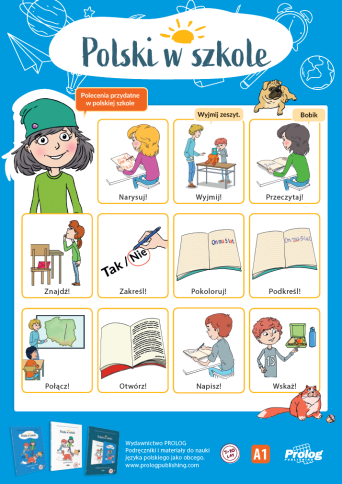
The poster “Polecenia przydatne w polskiej szkole”, 68 cm x 48 cm in size, which is an extremely useful teaching aid for the teacher of Polish as a foreign language for children in grades 1-3, will decorate the wall of the studio and will help to master the basic vocabulary useful in elementary school lessons. When purchasing the poster and book positions, the poster is shipped in a folded form. When purchasing only the poster - shipped in a tube. If the order is to be split into 2 packages, a surcharge for the second shipment is required (contact books@prolog.edu.pl).
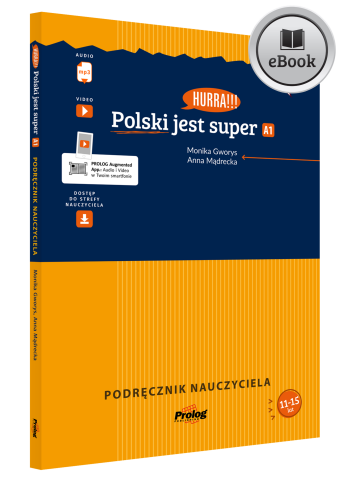
Obejrzyj przeglądy podręczników "Hurra!!! Polski jest super. A1" HURRA!!! Polski jest Super. A1. Teacher’s Book: contains a detailed description of each chapter from the student’s textbook presents the objectives of each task, includes didactic tips on how to carry them out (serves as a source of ready-made lesson plans) offers ideas for additional (not included in the student’s textbook) language activities that develop students’ vocabulary and language skills contains ready-to-copy board and card games marked in the student’s textbook with a dice symbol introduces additional (not included in the student’s textbook) games and language activities that can be used at specific stages of the lesson includes suggestions for games that do not require special materials to prepare or copy features a set of picture cards (vocabulary flashcards) for each chapter provides suggestions for language games using the flashcards indicates specific exercises from the workbook that students can do at a given stage of the lesson includes quizzes for student self-assessment (3 per chapter, checking vocabulary, grammar, and writing skills) provides access to the Teacher’s Zone with online videos, games, flashcards, boards, printable quizzes from the textbook, and additional materials for alternative implementation of the content The protagonists of the textbooks, videos, and audio recordings are a group of teenagers of various ages united by a shared passion for journalism. Together, they run the REPORTER’S CLUB blog. They record videos, present not only school life but also their passions, talk about travels, holidays, family, home, and various events important to them. Sample pages: I would like to emphasize that there has not yet been a publication on the Polish publishing market addressed to the target group indicated by the authors that constitutes such a comprehensive whole. An additional advantage of the publication is its full alignment with the communicative and action-oriented approach. Thus, it motivates learners by showing that they acquire skills they can use outside the classroom. (…) The work deserves recognition and will not only raise the language competence of learners and interest young people in Poland, but also motivate them to continue learning. The textbook and its accompanying materials encourage young learners not only with content that allows them to describe the world and their experiences in Polish, but also with the format of the materials. It motivates them to engage in language activities and to become autonomous in their learning process (not “I learn the language because I have to,” but “I want to”). The graphic and audiovisual design is an asset. Likewise, the inclusion of numerous games and language activities addresses the element of competition and active student participation.— from the review by dr hab. Aleksandra Achtelik, prof. UŚ


 Polish
 German